There are no items in your cart
Add More
| Item Details | Price | ||
|---|---|---|---|

These solutions are in interactive format: pick an option to check your answer, or open the text or video solution directly. If you wish to attempt them as a timed mock, then please visit this link.
Read the passage and answer the following questions
Socially, Latin America is a place of extreme inequalities. Enormous disparities of wealth and well-being exist within countries and between them. The Southern Cone countries have long stood respectably high in global rankings of social development, and most Latin American countries now hold middling rank, globally, in a combined measure of people's education, life expectancy, and buying power. The small countries of Central America (notably excepting Costa Rica) are worse off, as are those with large and historically oppressed populations of indigenous people, like Guatemala and Bolivia.
Latin America is probably the most racially diverse of world regions, fed from the gene pools of Europe, Africa, and indigenous America. All three elements are present in every country, and the possible configurations vary kaleidoscopically. Guatemala and Bolivia, along with Peru and Ecuador, are characterized by large populations of indigenous people who continue to speak native languages such as Quechua or Aymara, live more or less separately from Spanish speakers, and follow distinctive customs in clothing and food. African genes are a predominant element of the mix in Brazil and on the shores of the Caribbean. Latin America was the main destination of the millions of people enslaved and taken out of Africa between 1500 AD and 1850 AD. Whereas the United States received about 523,000 enslaved immigrants, Cuba alone got more, Brazil at least $3.5$ million. In addition, there are places in Latin America where people look notably European, particularly where large numbers of Italian immigrants were added to the population around 1900, such as in Argentina and Uruguay.
Probably most Latin Americans consider themselves to some degree "of mixed race," or mestizo, a key concept in Latin American history.
More than twenty countries share a single history as they have experienced a similar process of conquest and colonization. They became independent more or less the same way, mostly at the same time. They then struggled with similar problems in similar ways. Looking back after two centuries of independence, one sees that similar trends have washed over the entire region, giving Latin American history a well-defined ebb and flow.
Which of the following statements is not corroborated by the passage:
Read the passage and answer the following questions
Socially, Latin America is a place of extreme inequalities. Enormous disparities of wealth and well-being exist within countries and between them. The Southern Cone countries have long stood respectably high in global rankings of social development, and most Latin American countries now hold middling rank, globally, in a combined measure of people's education, life expectancy, and buying power. The small countries of Central America (notably excepting Costa Rica) are worse off, as are those with large and historically oppressed populations of indigenous people, like Guatemala and Bolivia.
Latin America is probably the most racially diverse of world regions, fed from the gene pools of Europe, Africa, and indigenous America. All three elements are present in every country, and the possible configurations vary kaleidoscopically. Guatemala and Bolivia, along with Peru and Ecuador, are characterized by large populations of indigenous people who continue to speak native languages such as Quechua or Aymara, live more or less separately from Spanish speakers, and follow distinctive customs in clothing and food. African genes are a predominant element of the mix in Brazil and on the shores of the Caribbean. Latin America was the main destination of the millions of people enslaved and taken out of Africa between 1500 AD and 1850 AD. Whereas the United States received about 523,000 enslaved immigrants, Cuba alone got more, Brazil at least $3.5$ million. In addition, there are places in Latin America where people look notably European, particularly where large numbers of Italian immigrants were added to the population around 1900, such as in Argentina and Uruguay.
Probably most Latin Americans consider themselves to some degree "of mixed race," or mestizo, a key concept in Latin American history.
More than twenty countries share a single history as they have experienced a similar process of conquest and colonization. They became independent more or less the same way, mostly at the same time. They then struggled with similar problems in similar ways. Looking back after two centuries of independence, one sees that similar trends have washed over the entire region, giving Latin American history a well-defined ebb and flow.
Which of the following countries did not receive slaves according to the passage:
Read the passage and answer the following questions
Socially, Latin America is a place of extreme inequalities. Enormous disparities of wealth and well-being exist within countries and between them. The Southern Cone countries have long stood respectably high in global rankings of social development, and most Latin American countries now hold middling rank, globally, in a combined measure of people's education, life expectancy, and buying power. The small countries of Central America (notably excepting Costa Rica) are worse off, as are those with large and historically oppressed populations of indigenous people, like Guatemala and Bolivia.
Latin America is probably the most racially diverse of world regions, fed from the gene pools of Europe, Africa, and indigenous America. All three elements are present in every country, and the possible configurations vary kaleidoscopically. Guatemala and Bolivia, along with Peru and Ecuador, are characterized by large populations of indigenous people who continue to speak native languages such as Quechua or Aymara, live more or less separately from Spanish speakers, and follow distinctive customs in clothing and food. African genes are a predominant element of the mix in Brazil and on the shores of the Caribbean. Latin America was the main destination of the millions of people enslaved and taken out of Africa between 1500 AD and 1850 AD. Whereas the United States received about 523,000 enslaved immigrants, Cuba alone got more, Brazil at least $3.5$ million. In addition, there are places in Latin America where people look notably European, particularly where large numbers of Italian immigrants were added to the population around 1900, such as in Argentina and Uruguay.
Probably most Latin Americans consider themselves to some degree "of mixed race," or mestizo, a key concept in Latin American history.
More than twenty countries share a single history as they have experienced a similar process of conquest and colonization. They became independent more or less the same way, mostly at the same time. They then struggled with similar problems in similar ways. Looking back after two centuries of independence, one sees that similar trends have washed over the entire region, giving Latin American history a well-defined ebb and flow.
Which of the following statements is not corroborated by the passage:
Read the passage and answer the following questions
Socially, Latin America is a place of extreme inequalities. Enormous disparities of wealth and well-being exist within countries and between them. The Southern Cone countries have long stood respectably high in global rankings of social development, and most Latin American countries now hold middling rank, globally, in a combined measure of people's education, life expectancy, and buying power. The small countries of Central America (notably excepting Costa Rica) are worse off, as are those with large and historically oppressed populations of indigenous people, like Guatemala and Bolivia.
Latin America is probably the most racially diverse of world regions, fed from the gene pools of Europe, Africa, and indigenous America. All three elements are present in every country, and the possible configurations vary kaleidoscopically. Guatemala and Bolivia, along with Peru and Ecuador, are characterized by large populations of indigenous people who continue to speak native languages such as Quechua or Aymara, live more or less separately from Spanish speakers, and follow distinctive customs in clothing and food. African genes are a predominant element of the mix in Brazil and on the shores of the Caribbean. Latin America was the main destination of the millions of people enslaved and taken out of Africa between 1500 AD and 1850 AD. Whereas the United States received about 523,000 enslaved immigrants, Cuba alone got more, Brazil at least $3.5$ million. In addition, there are places in Latin America where people look notably European, particularly where large numbers of Italian immigrants were added to the population around 1900, such as in Argentina and Uruguay.
Probably most Latin Americans consider themselves to some degree "of mixed race," or mestizo, a key concept in Latin American history.
More than twenty countries share a single history as they have experienced a similar process of conquest and colonization. They became independent more or less the same way, mostly at the same time. They then struggled with similar problems in similar ways. Looking back after two centuries of independence, one sees that similar trends have washed over the entire region, giving Latin American history a well-defined ebb and flow.
What are the two indigenous languages from the region?
Read the passage and answer the following questions
Socially, Latin America is a place of extreme inequalities. Enormous disparities of wealth and well-being exist within countries and between them. The Southern Cone countries have long stood respectably high in global rankings of social development, and most Latin American countries now hold middling rank, globally, in a combined measure of people's education, life expectancy, and buying power. The small countries of Central America (notably excepting Costa Rica) are worse off, as are those with large and historically oppressed populations of indigenous people, like Guatemala and Bolivia.
Latin America is probably the most racially diverse of world regions, fed from the gene pools of Europe, Africa, and indigenous America. All three elements are present in every country, and the possible configurations vary kaleidoscopically. Guatemala and Bolivia, along with Peru and Ecuador, are characterized by large populations of indigenous people who continue to speak native languages such as Quechua or Aymara, live more or less separately from Spanish speakers, and follow distinctive customs in clothing and food. African genes are a predominant element of the mix in Brazil and on the shores of the Caribbean. Latin America was the main destination of the millions of people enslaved and taken out of Africa between 1500 AD and 1850 AD. Whereas the United States received about 523,000 enslaved immigrants, Cuba alone got more, Brazil at least $3.5$ million. In addition, there are places in Latin America where people look notably European, particularly where large numbers of Italian immigrants were added to the population around 1900, such as in Argentina and Uruguay.
Probably most Latin Americans consider themselves to some degree "of mixed race," or mestizo, a key concept in Latin American history.
More than twenty countries share a single history as they have experienced a similar process of conquest and colonization. They became independent more or less the same way, mostly at the same time. They then struggled with similar problems in similar ways. Looking back after two centuries of independence, one sees that similar trends have washed over the entire region, giving Latin American history a well-defined ebb and flow.
Global rankings of social development include measures such as
Read the passage and answer the following questions
The emergence of an at-home industrial workforce had two main causes. The growth of global trade and the rise in per-person income from the 1600 s onwards raised demand for manufactured goods such as woollens and watches. But the emerging new technology was more suited to small-scale working than large-scale factories (the spinning jenny, the machine which kickstarted the industrial revolution, was not invented until the 1760 s). Homes were the obvious place to be.
What emerged was called the "putting-out system". Workers would collect raw materials, and sometimes equipment, from a central depot. They would return home and make the goods for a few days, before giving back the finished articles and getting paid. Workers were independent contractors: they were paid by the piece, not by the hour, and they had little if any guarantee of work week to week.
Accounts of what it was actually like to work from home in the 18 th and 19th centuries are few and far between. Many putting-out workers were women, who were less likely to write autobiographies (women's dominance in the putting-out system also explains why generations of historians have not paid it much attention). Some characteristics nonetheless emerge from the archives. Average working hours were longer. Unlike today, where most people have one job, people flitted from one task to another, depending on where money could be made....
Some economic historians suggest that workers were mercilessly exploited under the puttingout system. Those who owned the machines and raw materials enjoyed enormous power over those they employed. With workers dispersed across a county, it was difficult for them to team up against exploitative bosses to demand better pay, let alone form trade unions.
Bosses "could easily gang up against the rural spinner who faced a take-it-or-leave-it offer of work," argue Jane Humphries and Ben Schneider of Oxford University, in a paper from $2019 .$ Some workers truly struggled.
As a result, some historians welcome the development of the factory system from the late 18th century onwards. Workers moved from a place where domestic life intermingled freely with economic production to a place solely dedicated to the pursuit of efficiency. It is hardly surprising that labour productivity was higher in the factory, nor that the factory system gradually outperformed the putting-out system and came to replace it. Crammed together in a factory, workers could more easily club together to ask for higher wages; trade unions started to grow from the 1850 s onwards. According to English data, factory workers were paid 10 $20 \%$ more than home-workers.
But is that the whole story? Some home-workers resisted the shift to the factory systemmost notably by joining the Luddites, a society of English textile workers in the 19 th century who smashed up machines which they perceived were putting them out of a job. Another explanation is that factory owners, at least in the short term, had little option but to offer higher wages in order to entice workers from their homes. That suggests that home-working had its advantages.
One such advantage was economic. Home-workers may have been poorly paid relative to factory folk, but they could earn income by other means. Wool-industry home-workers would receive a given quantity of material and were then supposed to return the same weight of material fashioned into stockings. But by exposing the wool to steam, it would weigh more, allowing the workers to keep some of the raw materials.
The closest modern-day equivalent of 19 th century Luddites would be:
Read the passage and answer the following questions
The emergence of an at-home industrial workforce had two main causes. The growth of global trade and the rise in per-person income from the 1600 s onwards raised demand for manufactured goods such as woollens and watches. But the emerging new technology was more suited to small-scale working than large-scale factories (the spinning jenny, the machine which kickstarted the industrial revolution, was not invented until the 1760 s). Homes were the obvious place to be.
What emerged was called the "putting-out system". Workers would collect raw materials, and sometimes equipment, from a central depot. They would return home and make the goods for a few days, before giving back the finished articles and getting paid. Workers were independent contractors: they were paid by the piece, not by the hour, and they had little if any guarantee of work week to week.
Accounts of what it was actually like to work from home in the 18 th and 19th centuries are few and far between. Many putting-out workers were women, who were less likely to write autobiographies (women's dominance in the putting-out system also explains why generations of historians have not paid it much attention). Some characteristics nonetheless emerge from the archives. Average working hours were longer. Unlike today, where most people have one job, people flitted from one task to another, depending on where money could be made....
Some economic historians suggest that workers were mercilessly exploited under the puttingout system. Those who owned the machines and raw materials enjoyed enormous power over those they employed. With workers dispersed across a county, it was difficult for them to team up against exploitative bosses to demand better pay, let alone form trade unions.
Bosses "could easily gang up against the rural spinner who faced a take-it-or-leave-it offer of work," argue Jane Humphries and Ben Schneider of Oxford University, in a paper from $2019 .$ Some workers truly struggled.
As a result, some historians welcome the development of the factory system from the late 18th century onwards. Workers moved from a place where domestic life intermingled freely with economic production to a place solely dedicated to the pursuit of efficiency. It is hardly surprising that labour productivity was higher in the factory, nor that the factory system gradually outperformed the putting-out system and came to replace it. Crammed together in a factory, workers could more easily club together to ask for higher wages; trade unions started to grow from the 1850 s onwards. According to English data, factory workers were paid 10 $20 \%$ more than home-workers.
But is that the whole story? Some home-workers resisted the shift to the factory systemmost notably by joining the Luddites, a society of English textile workers in the 19 th century who smashed up machines which they perceived were putting them out of a job. Another explanation is that factory owners, at least in the short term, had little option but to offer higher wages in order to entice workers from their homes. That suggests that home-working had its advantages.
One such advantage was economic. Home-workers may have been poorly paid relative to factory folk, but they could earn income by other means. Wool-industry home-workers would receive a given quantity of material and were then supposed to return the same weight of material fashioned into stockings. But by exposing the wool to steam, it would weigh more, allowing the workers to keep some of the raw materials.
From the information given in the first paragraph of the passage it can be inferred that the demand for work-from-home workers will increase at present if,
Read the passage and answer the following questions
The emergence of an at-home industrial workforce had two main causes. The growth of global trade and the rise in per-person income from the 1600 s onwards raised demand for manufactured goods such as woollens and watches. But the emerging new technology was more suited to small-scale working than large-scale factories (the spinning jenny, the machine which kickstarted the industrial revolution, was not invented until the 1760 s). Homes were the obvious place to be.
What emerged was called the "putting-out system". Workers would collect raw materials, and sometimes equipment, from a central depot. They would return home and make the goods for a few days, before giving back the finished articles and getting paid. Workers were independent contractors: they were paid by the piece, not by the hour, and they had little if any guarantee of work week to week.
Accounts of what it was actually like to work from home in the 18 th and 19th centuries are few and far between. Many putting-out workers were women, who were less likely to write autobiographies (women's dominance in the putting-out system also explains why generations of historians have not paid it much attention). Some characteristics nonetheless emerge from the archives. Average working hours were longer. Unlike today, where most people have one job, people flitted from one task to another, depending on where money could be made....
Some economic historians suggest that workers were mercilessly exploited under the puttingout system. Those who owned the machines and raw materials enjoyed enormous power over those they employed. With workers dispersed across a county, it was difficult for them to team up against exploitative bosses to demand better pay, let alone form trade unions.
Bosses "could easily gang up against the rural spinner who faced a take-it-or-leave-it offer of work," argue Jane Humphries and Ben Schneider of Oxford University, in a paper from $2019 .$ Some workers truly struggled.
As a result, some historians welcome the development of the factory system from the late 18th century onwards. Workers moved from a place where domestic life intermingled freely with economic production to a place solely dedicated to the pursuit of efficiency. It is hardly surprising that labour productivity was higher in the factory, nor that the factory system gradually outperformed the putting-out system and came to replace it. Crammed together in a factory, workers could more easily club together to ask for higher wages; trade unions started to grow from the 1850 s onwards. According to English data, factory workers were paid 10 $20 \%$ more than home-workers.
But is that the whole story? Some home-workers resisted the shift to the factory systemmost notably by joining the Luddites, a society of English textile workers in the 19 th century who smashed up machines which they perceived were putting them out of a job. Another explanation is that factory owners, at least in the short term, had little option but to offer higher wages in order to entice workers from their homes. That suggests that home-working had its advantages.
One such advantage was economic. Home-workers may have been poorly paid relative to factory folk, but they could earn income by other means. Wool-industry home-workers would receive a given quantity of material and were then supposed to return the same weight of material fashioned into stockings. But by exposing the wool to steam, it would weigh more, allowing the workers to keep some of the raw materials.
From the passage it can be inferred that the best way for current employers to prevent employees working from home clubbing together to ask for higher wages and benefits would be to
Read the passage and answer the following questions
The emergence of an at-home industrial workforce had two main causes. The growth of global trade and the rise in per-person income from the 1600 s onwards raised demand for manufactured goods such as woollens and watches. But the emerging new technology was more suited to small-scale working than large-scale factories (the spinning jenny, the machine which kickstarted the industrial revolution, was not invented until the 1760 s). Homes were the obvious place to be.
What emerged was called the "putting-out system". Workers would collect raw materials, and sometimes equipment, from a central depot. They would return home and make the goods for a few days, before giving back the finished articles and getting paid. Workers were independent contractors: they were paid by the piece, not by the hour, and they had little if any guarantee of work week to week.
Accounts of what it was actually like to work from home in the 18 th and 19th centuries are few and far between. Many putting-out workers were women, who were less likely to write autobiographies (women's dominance in the putting-out system also explains why generations of historians have not paid it much attention). Some characteristics nonetheless emerge from the archives. Average working hours were longer. Unlike today, where most people have one job, people flitted from one task to another, depending on where money could be made....
Some economic historians suggest that workers were mercilessly exploited under the puttingout system. Those who owned the machines and raw materials enjoyed enormous power over those they employed. With workers dispersed across a county, it was difficult for them to team up against exploitative bosses to demand better pay, let alone form trade unions.
Bosses "could easily gang up against the rural spinner who faced a take-it-or-leave-it offer of work," argue Jane Humphries and Ben Schneider of Oxford University, in a paper from $2019 .$ Some workers truly struggled.
As a result, some historians welcome the development of the factory system from the late 18th century onwards. Workers moved from a place where domestic life intermingled freely with economic production to a place solely dedicated to the pursuit of efficiency. It is hardly surprising that labour productivity was higher in the factory, nor that the factory system gradually outperformed the putting-out system and came to replace it. Crammed together in a factory, workers could more easily club together to ask for higher wages; trade unions started to grow from the 1850 s onwards. According to English data, factory workers were paid 10 $20 \%$ more than home-workers.
But is that the whole story? Some home-workers resisted the shift to the factory systemmost notably by joining the Luddites, a society of English textile workers in the 19 th century who smashed up machines which they perceived were putting them out of a job. Another explanation is that factory owners, at least in the short term, had little option but to offer higher wages in order to entice workers from their homes. That suggests that home-working had its advantages.
One such advantage was economic. Home-workers may have been poorly paid relative to factory folk, but they could earn income by other means. Wool-industry home-workers would receive a given quantity of material and were then supposed to return the same weight of material fashioned into stockings. But by exposing the wool to steam, it would weigh more, allowing the workers to keep some of the raw materials.
It can be inferred from the passage that the number of women writing autobiographies in the 18 th and 19 th centuries would have been far higher if:
Read the passage and answer the following questions
The emergence of an at-home industrial workforce had two main causes. The growth of global trade and the rise in per-person income from the 1600 s onwards raised demand for manufactured goods such as woollens and watches. But the emerging new technology was more suited to small-scale working than large-scale factories (the spinning jenny, the machine which kickstarted the industrial revolution, was not invented until the 1760 s). Homes were the obvious place to be.
What emerged was called the "putting-out system". Workers would collect raw materials, and sometimes equipment, from a central depot. They would return home and make the goods for a few days, before giving back the finished articles and getting paid. Workers were independent contractors: they were paid by the piece, not by the hour, and they had little if any guarantee of work week to week.
Accounts of what it was actually like to work from home in the 18 th and 19th centuries are few and far between. Many putting-out workers were women, who were less likely to write autobiographies (women's dominance in the putting-out system also explains why generations of historians have not paid it much attention). Some characteristics nonetheless emerge from the archives. Average working hours were longer. Unlike today, where most people have one job, people flitted from one task to another, depending on where money could be made....
Some economic historians suggest that workers were mercilessly exploited under the puttingout system. Those who owned the machines and raw materials enjoyed enormous power over those they employed. With workers dispersed across a county, it was difficult for them to team up against exploitative bosses to demand better pay, let alone form trade unions.
Bosses "could easily gang up against the rural spinner who faced a take-it-or-leave-it offer of work," argue Jane Humphries and Ben Schneider of Oxford University, in a paper from $2019 .$ Some workers truly struggled.
As a result, some historians welcome the development of the factory system from the late 18th century onwards. Workers moved from a place where domestic life intermingled freely with economic production to a place solely dedicated to the pursuit of efficiency. It is hardly surprising that labour productivity was higher in the factory, nor that the factory system gradually outperformed the putting-out system and came to replace it. Crammed together in a factory, workers could more easily club together to ask for higher wages; trade unions started to grow from the 1850 s onwards. According to English data, factory workers were paid 10 $20 \%$ more than home-workers.
But is that the whole story? Some home-workers resisted the shift to the factory systemmost notably by joining the Luddites, a society of English textile workers in the 19 th century who smashed up machines which they perceived were putting them out of a job. Another explanation is that factory owners, at least in the short term, had little option but to offer higher wages in order to entice workers from their homes. That suggests that home-working had its advantages.
One such advantage was economic. Home-workers may have been poorly paid relative to factory folk, but they could earn income by other means. Wool-industry home-workers would receive a given quantity of material and were then supposed to return the same weight of material fashioned into stockings. But by exposing the wool to steam, it would weigh more, allowing the workers to keep some of the raw materials.
The closest modern-day equivalent of workers in the 'putting out' system that emerged in the 1600 s would be:
Select the correct word to fill-in the blank
"Rags to Riches" may be popular among story-tellers, but it isn't necessarily the emotional ________ that readers reach for most.
Select the correct word to fill-in the blank
To humans it seems remarkable but we're still determining whether this is par _________ course for these magnificent birds.
The four sentences (labelled A, B, C, D) below, when properly sequenced would yield a coherent paragraph. Decide on the proper sequencing of the order of the sentences and select the correct sequence as your answer:
A. Exasperatingly, in Enola Holmes, fictional characters are given greater responsibility for real-life feminism than the real people who actually built it
B. Deleting Watson and dampening Sherlock are not ultimately problems in the scheme of things; what is a problem is that the film deletes the accomplishments of all other women from this era.
C. Like so many Victorian-set modern stories, Enola Holmes seems to believe that its central female characters-Enola, her mother Eudoria, and Eudoria's mysterious club of badass women, including a Black jujitsu master named Edith (Susan Wokoma)_are the only pro-women women left in the country since the death of trailblazing writer Mary Wollstonecraft in $1797 .$
D. The seeming insistence that Enola has to carry feminism on her shoulders ultimately makes the film grow frustrating.
The four sentences (labelled A, B, C, D) below, when properly sequenced would yield a coherent paragraph. Decide on the proper sequencing of the order of the sentences and select the correct sequence as your answer:
A. He not only studied the human body but also animal anatomy, Ophthalmics, the laws of muscular movements, and botany.
B. Leonardo da Vinci was one of the finest artists the world has ever known.
C. He was a genius whose many-sided talent has seldom, if ever, been matched in the history of the world.
D. He was a pioneer in these sciences.
The four sentences (labelled A, B, C, D) below, when properly sequenced would yield a coherent paragraph. Decide on the proper sequencing of the order of the sentences and select the correct sequence as your answer:
A. Although rare, this ability to recognize you are in a dream-and even control some aspects of it-can be enhanced with training.
B. But these recorded only minimal responses from the sleepers and did not involve complex transmission of information.
C. A few studies have tried to communicate with lucid dreamers using stimuli such as lights, shocks, and sounds to "enter" people's dreams.
D. Scientists have observed the phenomenon of lucid dreaming since the 1970 s in experiments about the rapid eye movement (REM) phase of sleep.
If the total budget doubled in 2019-20 compared to 2018-19, which sector experienced the maximum proportionate change in the actual budget allocation?
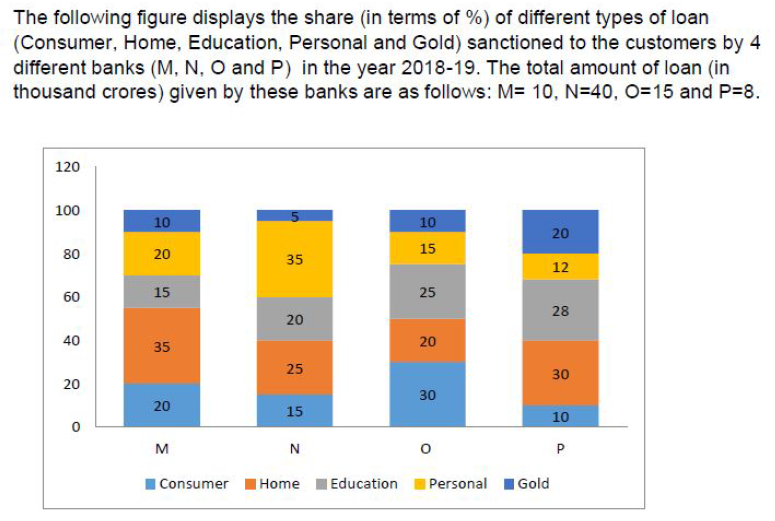
If the banks are ordered by descending ratios of Personal loan to Consumer loan, the order will be:
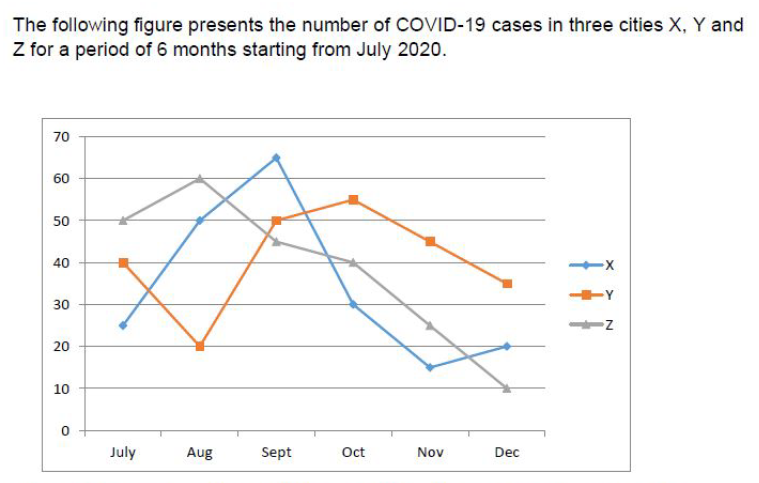
The average number of cases in the three cities $(X, Y, Z)$ over the period of six months
The following bar graph shows the revenue (in crores) of five steel manufacturers: P, Q, R, S and T in the first quarter (Q1), the second quarter (Q2), the third quarter (Q3) and the fourth quarter (Q4).
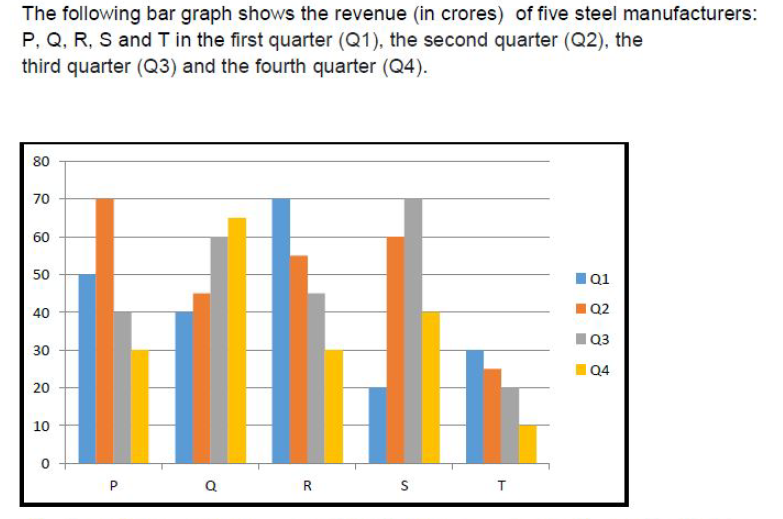
Which manufacturer had the maximum decline in growth rate in $Q 4$ compared to Q2?
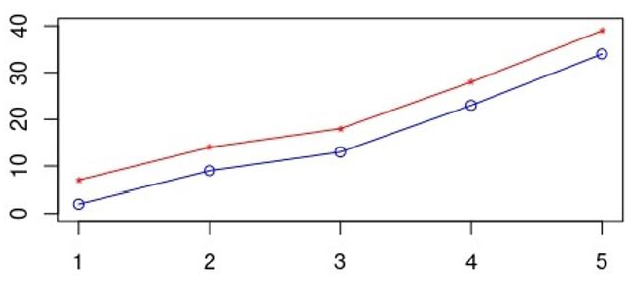
The above graph shows for five consecutive years, the number of graduating students from two different universities getting salary offers of more than 20 lakhs per year. It can be concluded from the graph that:
There are five serially numbered black boxes (B1, B2, B3. B4 and B5 ) and five serially numbered white boxes (W1, W2, W3, W4 and W5). Each of these ten boxes contains at least one marble and at the most six marbles, such that the following conditions are also satisfied:
(i) No two black boxes contain the same number of marbles. Similarly, no two white boxes contain the same number of marbles.
(ii) B3 and W3 contain an equal number of marbles. No two other boxes with the same serial number on them contain the same number of marbles.
(iii) B1 and B2 together contain the same number of marbles as contained in the remaining black boxes.
(iv) The white boxes together contain 4 more marbles than the number of marbles contained in all the black boxes combined.
(v) If the marbles in B1 are switched with those contained in W1, the black boxes together will end up containing the same number of marbles as the white boxes combined.
(vi) B5 contains twice the number of marbles contained in W5.
Which of the following boxes contain the same number of marbles as contained in B1 and W5 combined?
There are five serially numbered black boxes (B1, B2, B3. B4 and B5 ) and five serially numbered white boxes (W1, W2, W3, W4 and W5). Each of these ten boxes contains at least one marble and at the most six marbles, such that the following conditions are also satisfied:
(i) No two black boxes contain the same number of marbles. Similarly, no two white boxes contain the same number of marbles.
(ii) B3 and W3 contain an equal number of marbles. No two other boxes with the same serial number on them contain the same number of marbles.
(iii) B1 and B2 together contain the same number of marbles as contained in the remaining black boxes.
(iv) The white boxes together contain 4 more marbles than the number of marbles contained in all the black boxes combined.
(v) If the marbles in B1 are switched with those contained in W1, the black boxes together will end up containing the same number of marbles as the white boxes combined.
(vi) B5 contains twice the number of marbles contained in W5.
How many marbles are contained in B4?
There are five serially numbered black boxes (B1, B2, B3. B4 and B5 ) and five serially numbered white boxes (W1, W2, W3, W4 and W5). Each of these ten boxes contains at least one marble and at the most six marbles, such that the following conditions are also satisfied:
(i) No two black boxes contain the same number of marbles. Similarly, no two white boxes contain the same number of marbles.
(ii) B3 and W3 contain an equal number of marbles. No two other boxes with the same serial number on them contain the same number of marbles.
(iii) B1 and B2 together contain the same number of marbles as contained in the remaining black boxes.
(iv) The white boxes together contain 4 more marbles than the number of marbles contained in all the black boxes combined.
(v) If the marbles in B1 are switched with those contained in W1, the black boxes together will end up containing the same number of marbles as the white boxes combined.
(vi) B5 contains twice the number of marbles contained in W5.
Which one among the following boxes contains the maximum number of marbles?
There are five serially numbered black boxes (B1, B2, B3. B4 and B5 ) and five serially numbered white boxes (W1, W2, W3, W4 and W5). Each of these ten boxes contains at least one marble and at the most six marbles, such that the following conditions are also satisfied:
(i) No two black boxes contain the same number of marbles. Similarly, no two white boxes contain the same number of marbles.
(ii) B3 and W3 contain an equal number of marbles. No two other boxes with the same serial number on them contain the same number of marbles.
(iii) B1 and B2 together contain the same number of marbles as contained in the remaining black boxes.
(iv) The white boxes together contain 4 more marbles than the number of marbles contained in all the black boxes combined.
(v) If the marbles in B1 are switched with those contained in W1, the black boxes together will end up containing the same number of marbles as the white boxes combined.
(vi) B5 contains twice the number of marbles contained in W5.
How many marbles are contained in B2?
There are five serially numbered black boxes (B1, B2, B3. B4 and B5 ) and five serially numbered white boxes (W1, W2, W3, W4 and W5). Each of these ten boxes contains at least one marble and at the most six marbles, such that the following conditions are also satisfied:
(i) No two black boxes contain the same number of marbles. Similarly, no two white boxes contain the same number of marbles.
(ii) B3 and W3 contain an equal number of marbles. No two other boxes with the same serial number on them contain the same number of marbles.
(iii) B1 and B2 together contain the same number of marbles as contained in the remaining black boxes.
(iv) The white boxes together contain 4 more marbles than the number of marbles contained in all the black boxes combined.
(v) If the marbles in B1 are switched with those contained in W1, the black boxes together will end up containing the same number of marbles as the white boxes combined.
(vi) B5 contains twice the number of marbles contained in W5.
Which of the following is NOT the number of marbles contained in any of the white boxes?
The integer closest to $(1+1 / 100)^{200}$ is
The antiderivative of $f(x)=\tan ^{-1}(\sqrt{x})$ whose graph passes through the point $(0,2)$ is
Let
$$
f(x)=\cos ^{2}(x)+\cos ^{2}\left(\frac{\pi}{3}+x\right)-\cos (x) \cos \left(\frac{\pi}{3}+x\right)
$$
Then
The value of the integral
$$
\int_{-1}^{1} x^{3}|x| d x
$$
is
The value of
$$
\lim _{x \rightarrow 0} \frac{(1+x)^{1 / 6}-(1-x)^{1 / 6}}{x}
$$
The area of the region enclosed by $y=x^{2}, y=-x^{2}, x=1$ & $x=-1$ is
The total number of ways in which the letters of the word "COMBINATIONS" can be arranged such that
(i) $\quad C$ comes before $S$ and
(ii) There are exactly 4 letters (not necessarily distinct) in between C and $S$
equals
The number of ways 3 cricket players can be selected from a pool of 2 batsmen, 3 bowlers and 4 fielders so that at least one bowler is included, is
What is the number of common tangents to the circles
$$
\begin{gathered}
(x+1)^{2}+(y+4)^{2}=40 \\
(x-2)^{2}+(y-5)^{2}=10 ?
\end{gathered}
$$
On the line joining two points $A(0,4)$ and $B(3,0)$, a square $A B C D$ is constructed on the side of the line away from origin. The coordinates of $C$ are
Let
$$
f(x)=\frac{1}{1+x^{2}} \int_{1}^{x}\left[2 t^{2}-f^{\prime}(t)\right] d t
$$
Then the value of $f^{\prime}(1)$ is
Consider the function $f(x)=\tan (\pi[x-\pi / 2]) /\left(2+[x]^{2}\right)$, where $[x]$ denotes the largest integer not exceeding $x$. Then $f(x)$ is:
Suppose P is a point in the Euclidean plane such that the tangents drawn from $P$ to the parabola $x^{2}=4 a y$ are perpendicular to each other. The locus of $P$ is
The altitude of a rock is observed to be $45^{\circ}$. After ascending 1 kilometer towards it up a slope inclined at $30^{\circ}$, the elevation is found to be $60^{\circ}$. The height of the rock above the first point of observation is
If the sides of a right angled triangle are in Geometric Progression, then value of the cosine of the greater acute angle is
In a survey of 100 executives regarding the use of different types of credit cards, it is found that 60 use Master, 20 only Visa, 30 only Master and 10 only American Express. Further it is found that 20 use Master and Visa cards but not American Express, 6 only use Master and American Express cards but not Visa. The exact number of executives who use Visa and American Express cards is
If $a$ and $b$ are real numbers, the equation $x-1 / x=a x+b$
Suppose that the roots of the equation $a x^{2}+b x+c=0$ are real and of opposite signs. If the sum of the roots is negative, then,
The integral part of $(5+\sqrt{17})^{2021}$ is
Suppose $x$ and $y$ are prime numbers. Consider the equation
$$
y^{2}-2 x^{2}=1
$$
Then:
The highest power of 5 that divides 518 ! is
Suppose $P$ is a $3 \times 3$ matrix given by:
$$
\left[\begin{array}{lll}
0 & 1 & 0 \\
0 & 1 & 0 \\
0 & 0 & 1
\end{array}\right]
$$
Let I denote the $3 \times 3$ identity matrix. Then $\mathrm{P}^{20}(I-\mathrm{P})^{21}$ equals
An individual continues to roll a fair die till he/she has obtained at least two different faces. What is the probability that the total number of rolls required to satisfy the objective is 4 ?
Consider the polynomial $f(x)=\sum_{i=0}^{n}\left(a_{0}+i\right) x^{2 i}$ where $a_{0}$ is a positive constant. Then $f(x)$ has
Question 50 of PGDBA 2021 was a wrong question in the paper (the answer key lists it as "Wrong Question") and was not evaluated. The question text is not available in any of the sources.