There are no items in your cart
Add More
| Item Details | Price | ||
|---|---|---|---|

These solutions are in interactive format: pick an option to check your answer, or open the text or video solution directly. If you wish to attempt them as a timed mock, then please visit this link.
Read the passage below and choose the most appropriate answer for the questions that follow.
One pictured a woman holding an hourglass next to the words: "Beauty has no age limit. Fertility does." Another portrayed a pair of baby shoes wrapped in a ribbon of the Italian flag. Yet another showed a man holding a half-burned cigarette: "Don't let your sperm go up in smoke" it read.
Were they part of a government effort to promote "Fertility Day" on Sept. 22? A campaign intended to encourage Italians to have more babies. Instead, the ads set off a furore were denounced as being offensive, and within days were withdraw. What they did succeed in doing, however, was to ignite a deeper and lasting debate about why it is that Italy has one of the lowest birthrates in the world, and what can be done about it.
The problem is not a lack of desire to have children, critics of the campaign say, but rather the lack of meaningful support provided by the government and many employers in a country where the family remains the primary source of child care. Many working women, without an extended family to care for a child, face a dilemma, as private child care is expensive. Some also worry that their job security may be undermined by missing workdays because of child care issues. Many companies do not offer flexible hours for working mothers.
Not surprisingly, Italy's long slowdown in childbirth has coincided with its recent economic slump. But Italian families have been shrinking for decades. In 2015, 488,000 babies were born in Italy, the fewest since the country first unified in 1861. It has one of the lowest birthrates in Europe, with 1.37 children per woman, compared with a European average of 1.6, according to Eurostat figures. By contrast, in France, the economy has been flat, too, but a family-oriented system provides a far more generous social safety net that includes daycare and subsidies for families to have children. There, women have two children each on average.
The Ministry of Health began the fertility campaign on Aug. 31 with a group of online advertisements and a hashtag on Twitter. The goal was to publicize a series of public meetings on Fertility Day and encourage Italians to have more children. Even Prime Minister Matteo Renzi, whose own health minister started the campaign distanced himself from the ads in a radio interview. Under Mr Renzi, Italy's government has paid families with a so-called baby bonus of 80 to 160 euros, or about
But Italy allocates only 1 per cent of its gross domestic product to social protection benefits — half the European average. One child out of three here is at risk of relative poverty.Italy's health minister, Beatrice Lorenzin, responding on Facebook, wrote that the Fertility Day, the campaign was not a "call to reproduction" but a day to discuss "the fertility issues that 15 per cent of Italians deal with." She promptly cancelled the campaign. "I am saddened that the launch of the advertising campaign misled many people," Ms.Lorenzine said. "I withdrew it to change it."
The passage mentions that the idea of "Fertility Day" was "denounced as being offensive" According to the campaign. what exactly did the Italians find "offensive"?
Read the passage below and choose the most appropriate answer for the questions that follow.
One pictured a woman holding an hourglass next to the words: "Beauty has no age limit. Fertility does." Another portrayed a pair of baby shoes wrapped in a ribbon of the Italian flag. Yet another showed a man holding a half-burned cigarette: "Don't let your sperm go up in smoke" it read.
Were they part of a government effort to promote "Fertility Day" on Sept. 22? A campaign intended to encourage Italians to have more babies. Instead, the ads set off a furore were denounced as being offensive, and within days were withdraw. What they did succeed in doing, however, was to ignite a deeper and lasting debate about why it is that Italy has one of the lowest birthrates in the world, and what can be done about it.
The problem is not a lack of desire to have children, critics of the campaign say, but rather the lack of meaningful support provided by the government and many employers in a country where the family remains the primary source of child care. Many working women, without an extended family to care for a child, face a dilemma, as private child care is expensive. Some also worry that their job security may be undermined by missing workdays because of child care issues. Many companies do not offer flexible hours for working mothers.
Not surprisingly, Italy's long slowdown in childbirth has coincided with its recent economic slump. But Italian families have been shrinking for decades. In 2015, 488,000 babies were born in Italy, the fewest since the country first unified in 1861. It has one of the lowest birthrates in Europe, with 1.37 children per woman, compared with a European average of 1.6, according to Eurostat figures. By contrast, in France, the economy has been flat, too, but a family-oriented system provides a far more generous social safety net that includes daycare and subsidies for families to have children. There, women have two children each on average.
The Ministry of Health began the fertility campaign on Aug. 31 with a group of online advertisements and a hashtag on Twitter. The goal was to publicize a series of public meetings on Fertility Day and encourage Italians to have more children. Even Prime Minister Matteo Renzi, whose own health minister started the campaign distanced himself from the ads in a radio interview. Under Mr Renzi, Italy's government has paid families with a so-called baby bonus of 80 to 160 euros, or about
But Italy allocates only 1 per cent of its gross domestic product to social protection benefits — half the European average. One child out of three here is at risk of relative poverty.Italy's health minister, Beatrice Lorenzin, responding on Facebook, wrote that the Fertility Day, the campaign was not a "call to reproduction" but a day to discuss "the fertility issues that 15 per cent of Italians deal with." She promptly cancelled the campaign. "I am saddened that the launch of the advertising campaign misled many people," Ms.Lorenzine said. "I withdrew it to change it."
Based on the passage, which of the following measures will not have a meaningful impact on Italy's fertility rate even if the government worked hard to implement them?
Read the passage below and choose the most appropriate answer for the questions that follow.
One pictured a woman holding an hourglass next to the words: "Beauty has no age limit. Fertility does." Another portrayed a pair of baby shoes wrapped in a ribbon of the Italian flag. Yet another showed a man holding a half-burned cigarette: "Don't let your sperm go up in smoke" it read.
Were they part of a government effort to promote "Fertility Day" on Sept. 22? A campaign intended to encourage Italians to have more babies. Instead, the ads set off a furore were denounced as being offensive, and within days were withdraw. What they did succeed in doing, however, was to ignite a deeper and lasting debate about why it is that Italy has one of the lowest birthrates in the world, and what can be done about it.
The problem is not a lack of desire to have children, critics of the campaign say, but rather the lack of meaningful support provided by the government and many employers in a country where the family remains the primary source of child care. Many working women, without an extended family to care for a child, face a dilemma, as private child care is expensive. Some also worry that their job security may be undermined by missing workdays because of child care issues. Many companies do not offer flexible hours for working mothers.
Not surprisingly, Italy's long slowdown in childbirth has coincided with its recent economic slump. But Italian families have been shrinking for decades. In 2015, 488,000 babies were born in Italy, the fewest since the country first unified in 1861. It has one of the lowest birthrates in Europe, with 1.37 children per woman, compared with a European average of 1.6, according to Eurostat figures. By contrast, in France, the economy has been flat, too, but a family-oriented system provides a far more generous social safety net that includes daycare and subsidies for families to have children. There, women have two children each on average.
The Ministry of Health began the fertility campaign on Aug. 31 with a group of online advertisements and a hashtag on Twitter. The goal was to publicize a series of public meetings on Fertility Day and encourage Italians to have more children. Even Prime Minister Matteo Renzi, whose own health minister started the campaign distanced himself from the ads in a radio interview. Under Mr Renzi, Italy's government has paid families with a so-called baby bonus of 80 to 160 euros, or about
But Italy allocates only 1 per cent of its gross domestic product to social protection benefits — half the European average. One child out of three here is at risk of relative poverty.Italy's health minister, Beatrice Lorenzin, responding on Facebook, wrote that the Fertility Day, the campaign was not a "call to reproduction" but a day to discuss "the fertility issues that 15 per cent of Italians deal with." She promptly cancelled the campaign. "I am saddened that the launch of the advertising campaign misled many people," Ms.Lorenzine said. "I withdrew it to change it."
Which of the following words best captures Prime Minister Matteo Renzi's reaction to the fertility campaign?
Read the passage below and choose the most appropriate answer for the questions that follow.
One pictured a woman holding an hourglass next to the words: "Beauty has no age limit. Fertility does." Another portrayed a pair of baby shoes wrapped in a ribbon of the Italian flag. Yet another showed a man holding a half-burned cigarette: "Don't let your sperm go up in smoke" it read.
Were they part of a government effort to promote "Fertility Day" on Sept. 22? A campaign intended to encourage Italians to have more babies. Instead, the ads set off a furore were denounced as being offensive, and within days were withdraw. What they did succeed in doing, however, was to ignite a deeper and lasting debate about why it is that Italy has one of the lowest birthrates in the world, and what can be done about it.
The problem is not a lack of desire to have children, critics of the campaign say, but rather the lack of meaningful support provided by the government and many employers in a country where the family remains the primary source of child care. Many working women, without an extended family to care for a child, face a dilemma, as private child care is expensive. Some also worry that their job security may be undermined by missing workdays because of child care issues. Many companies do not offer flexible hours for working mothers.
Not surprisingly, Italy's long slowdown in childbirth has coincided with its recent economic slump. But Italian families have been shrinking for decades. In 2015, 488,000 babies were born in Italy, the fewest since the country first unified in 1861. It has one of the lowest birthrates in Europe, with 1.37 children per woman, compared with a European average of 1.6, according to Eurostat figures. By contrast, in France, the economy has been flat, too, but a family-oriented system provides a far more generous social safety net that includes daycare and subsidies for families to have children. There, women have two children each on average.
The Ministry of Health began the fertility campaign on Aug. 31 with a group of online advertisements and a hashtag on Twitter. The goal was to publicize a series of public meetings on Fertility Day and encourage Italians to have more children. Even Prime Minister Matteo Renzi, whose own health minister started the campaign distanced himself from the ads in a radio interview. Under Mr Renzi, Italy's government has paid families with a so-called baby bonus of 80 to 160 euros, or about
But Italy allocates only 1 per cent of its gross domestic product to social protection benefits — half the European average. One child out of three here is at risk of relative poverty.Italy's health minister, Beatrice Lorenzin, responding on Facebook, wrote that the Fertility Day, the campaign was not a "call to reproduction" but a day to discuss "the fertility issues that 15 per cent of Italians deal with." She promptly cancelled the campaign. "I am saddened that the launch of the advertising campaign misled many people," Ms.Lorenzine said. "I withdrew it to change it."
According to the passage, what is the key reason for Italy's low fertility rate?
Read the passage below and choose the most appropriate answer for the questions that follow.
One pictured a woman holding an hourglass next to the words: "Beauty has no age limit. Fertility does." Another portrayed a pair of baby shoes wrapped in a ribbon of the Italian flag. Yet another showed a man holding a half-burned cigarette: "Don't let your sperm go up in smoke" it read.
Were they part of a government effort to promote "Fertility Day" on Sept. 22? A campaign intended to encourage Italians to have more babies. Instead, the ads set off a furore were denounced as being offensive, and within days were withdraw. What they did succeed in doing, however, was to ignite a deeper and lasting debate about why it is that Italy has one of the lowest birthrates in the world, and what can be done about it.
The problem is not a lack of desire to have children, critics of the campaign say, but rather the lack of meaningful support provided by the government and many employers in a country where the family remains the primary source of child care. Many working women, without an extended family to care for a child, face a dilemma, as private child care is expensive. Some also worry that their job security may be undermined by missing workdays because of child care issues. Many companies do not offer flexible hours for working mothers.
Not surprisingly, Italy's long slowdown in childbirth has coincided with its recent economic slump. But Italian families have been shrinking for decades. In 2015, 488,000 babies were born in Italy, the fewest since the country first unified in 1861. It has one of the lowest birthrates in Europe, with 1.37 children per woman, compared with a European average of 1.6, according to Eurostat figures. By contrast, in France, the economy has been flat, too, but a family-oriented system provides a far more generous social safety net that includes daycare and subsidies for families to have children. There, women have two children each on average.
The Ministry of Health began the fertility campaign on Aug. 31 with a group of online advertisements and a hashtag on Twitter. The goal was to publicize a series of public meetings on Fertility Day and encourage Italians to have more children. Even Prime Minister Matteo Renzi, whose own health minister started the campaign distanced himself from the ads in a radio interview. Under Mr Renzi, Italy's government has paid families with a so-called baby bonus of 80 to 160 euros, or about
But Italy allocates only 1 per cent of its gross domestic product to social protection benefits — half the European average. One child out of three here is at risk of relative poverty.Italy's health minister, Beatrice Lorenzin, responding on Facebook, wrote that the Fertility Day, the campaign was not a "call to reproduction" but a day to discuss "the fertility issues that 15 per cent of Italians deal with." She promptly cancelled the campaign. "I am saddened that the launch of the advertising campaign misled many people," Ms.Lorenzine said. "I withdrew it to change it."
Which one of the following sentences is inaccurate based on all the facts detailed in the passage?
Read the passage below and choose the most appropriate answer for the questions that follow.
The 'trolley problem' used to be an obscure question in philosophical ethics. It runs as follows: a trolley, or a train, is speeding down a track towards a junction. Some moustache-twirling evildoer has tied five people to the track ahead and another person to the branch line. You are standing next to a lever that controls the junction. Do nothing, and the five people will be killed. Pull the lever, and only one person dies. What is the ethical course of action?
The excitement around self-driving cars, though, has made the problem famous. A truly self-driving car, after all, will have to be given ethical instructions of some sort by its human programmers. That has led to a miniature boom for the world's small band of professional ethicists, who suddenly find themselves in hot demand.
In a paper just published in Nature, a team of psychologists and computer scientists describe a different approach. Rather than asking said a small band of philosophers for their thoughts, this team, led by Edmond Awad of the Massachusetts Institute of Technology (MIT), decided instead to ask the general public. They created the "Moral Machine", a website which presents visitors with a series of choices about whom to save and whom to kill. In one, for instance, a self-driving car experiences brake an ahead of a pedestrian crossing. If it carries on in a straight line, a man, a woman and two homeless people of unspecified sex will be run down. If it serves, the death count will be the same, but the victims will be two women and two male business executives. What should the car do?
The strongest preferences, expressed by respondents from all over the world, were for saving human lives over animal ones,preferring to save many rather than few and prioritising children over the old. There were weaker preferences for saving women over men, pedestrians over passengers in the car and for taking action rather than doing nothing. Criminals were seen as literally sub-human ranking below dogs in the public's priority list, above cats.
Preferences differed between countries. The preference for saving women, for instance, was stronger in places with higher levels of gender equality. The researchers found that the world's countries clustered into three broad categories, which they dubbed "western" covering North America and the Christian cultural countries of Europe, "Eastern", including the Middle East, India and China and "Southern" Latin America and many of France's Former colonial possessions. Countries in the Eastern cluster, for instance, showed a weaker preference for sparing the young over the elderly, while the preference for humans over animals was less pronounced in southern nations. Self-driving cars, it seems, may need the ability to download new moralities when they cross national borders.
Which of the following, if achieved, might solve the ethical dilemmas faced by those designing navigation software for driverless cars?
Read the passage below and choose the most appropriate answer for the questions that follow.
The 'trolley problem' used to be an obscure question in philosophical ethics. It runs as follows: a trolley, or a train, is speeding down a track towards a junction. Some moustache-twirling evildoer has tied five people to the track ahead and another person to the branch line. You are standing next to a lever that controls the junction. Do nothing, and the five people will be killed. Pull the lever, and only one person dies. What is the ethical course of action?
The excitement around self-driving cars, though, has made the problem famous. A truly self-driving car, after all, will have to be given ethical instructions of some sort by its human programmers. That has led to a miniature boom for the world's small band of professional ethicists, who suddenly find themselves in hot demand.
In a paper just published in Nature, a team of psychologists and computer scientists describe a different approach. Rather than asking said a small band of philosophers for their thoughts, this team, led by Edmond Awad of the Massachusetts Institute of Technology (MIT), decided instead to ask the general public. They created the "Moral Machine", a website which presents visitors with a series of choices about whom to save and whom to kill. In one, for instance, a self-driving car experiences brake an ahead of a pedestrian crossing. If it carries on in a straight line, a man, a woman and two homeless people of unspecified sex will be run down. If it serves, the death count will be the same, but the victims will be two women and two male business executives. What should the car do?
The strongest preferences, expressed by respondents from all over the world, were for saving human lives over animal ones,preferring to save many rather than few and prioritising children over the old. There were weaker preferences for saving women over men, pedestrians over passengers in the car and for taking action rather than doing nothing. Criminals were seen as literally sub-human ranking below dogs in the public's priority list, above cats.
Preferences differed between countries. The preference for saving women, for instance, was stronger in places with higher levels of gender equality. The researchers found that the world's countries clustered into three broad categories, which they dubbed "western" covering North America and the Christian cultural countries of Europe, "Eastern", including the Middle East, India and China and "Southern" Latin America and many of France's Former colonial possessions. Countries in the Eastern cluster, for instance, showed a weaker preference for sparing the young over the elderly, while the preference for humans over animals was less pronounced in southern nations. Self-driving cars, it seems, may need the ability to download new moralities when they cross national borders.
Regulatory approval of which of the following preferences of car-navigation software is likely to face most uncertainty in a 'Southern' country with high levels of gender in-equality?
Read the passage below and choose the most appropriate answer for the questions that follow.
The 'trolley problem' used to be an obscure question in philosophical ethics. It runs as follows: a trolley, or a train, is speeding down a track towards a junction. Some moustache-twirling evildoer has tied five people to the track ahead and another person to the branch line. You are standing next to a lever that controls the junction. Do nothing, and the five people will be killed. Pull the lever, and only one person dies. What is the ethical course of action?
The excitement around self-driving cars, though, has made the problem famous. A truly self-driving car, after all, will have to be given ethical instructions of some sort by its human programmers. That has led to a miniature boom for the world's small band of professional ethicists, who suddenly find themselves in hot demand.
In a paper just published in Nature, a team of psychologists and computer scientists describe a different approach. Rather than asking said a small band of philosophers for their thoughts, this team, led by Edmond Awad of the Massachusetts Institute of Technology (MIT), decided instead to ask the general public. They created the "Moral Machine", a website which presents visitors with a series of choices about whom to save and whom to kill. In one, for instance, a self-driving car experiences brake an ahead of a pedestrian crossing. If it carries on in a straight line, a man, a woman and two homeless people of unspecified sex will be run down. If it serves, the death count will be the same, but the victims will be two women and two male business executives. What should the car do?
The strongest preferences, expressed by respondents from all over the world, were for saving human lives over animal ones,preferring to save many rather than few and prioritising children over the old. There were weaker preferences for saving women over men, pedestrians over passengers in the car and for taking action rather than doing nothing. Criminals were seen as literally sub-human ranking below dogs in the public's priority list, above cats.
Preferences differed between countries. The preference for saving women, for instance, was stronger in places with higher levels of gender equality. The researchers found that the world's countries clustered into three broad categories, which they dubbed "western" covering North America and the Christian cultural countries of Europe, "Eastern", including the Middle East, India and China and "Southern" Latin America and many of France's Former colonial possessions. Countries in the Eastern cluster, for instance, showed a weaker preference for sparing the young over the elderly, while the preference for humans over animals was less pronounced in southern nations. Self-driving cars, it seems, may need the ability to download new moralities when they cross national borders.
Which of the following references in driverless-car navigation software is likely to get acceptance from the largest number of countries?
Read the passage below and choose the most appropriate answer for the questions that follow.
The 'trolley problem' used to be an obscure question in philosophical ethics. It runs as follows: a trolley, or a train, is speeding down a track towards a junction. Some moustache-twirling evildoer has tied five people to the track ahead and another person to the branch line. You are standing next to a lever that controls the junction. Do nothing, and the five people will be killed. Pull the lever, and only one person dies. What is the ethical course of action?
The excitement around self-driving cars, though, has made the problem famous. A truly self-driving car, after all, will have to be given ethical instructions of some sort by its human programmers. That has led to a miniature boom for the world's small band of professional ethicists, who suddenly find themselves in hot demand.
In a paper just published in Nature, a team of psychologists and computer scientists describe a different approach. Rather than asking said a small band of philosophers for their thoughts, this team, led by Edmond Awad of the Massachusetts Institute of Technology (MIT), decided instead to ask the general public. They created the "Moral Machine", a website which presents visitors with a series of choices about whom to save and whom to kill. In one, for instance, a self-driving car experiences brake an ahead of a pedestrian crossing. If it carries on in a straight line, a man, a woman and two homeless people of unspecified sex will be run down. If it serves, the death count will be the same, but the victims will be two women and two male business executives. What should the car do?
The strongest preferences, expressed by respondents from all over the world, were for saving human lives over animal ones,preferring to save many rather than few and prioritising children over the old. There were weaker preferences for saving women over men, pedestrians over passengers in the car and for taking action rather than doing nothing. Criminals were seen as literally sub-human ranking below dogs in the public's priority list, above cats.
Preferences differed between countries. The preference for saving women, for instance, was stronger in places with higher levels of gender equality. The researchers found that the world's countries clustered into three broad categories, which they dubbed "western" covering North America and the Christian cultural countries of Europe, "Eastern", including the Middle East, India and China and "Southern" Latin America and many of France's Former colonial possessions. Countries in the Eastern cluster, for instance, showed a weaker preference for sparing the young over the elderly, while the preference for humans over animals was less pronounced in southern nations. Self-driving cars, it seems, may need the ability to download new moralities when they cross national borders.
The statement "self-driving cars...may need the ability to download new moralities when they cross national borders" implies that,
Read the passage below and choose the most appropriate answer for the questions that follow.
The 'trolley problem' used to be an obscure question in philosophical ethics. It runs as follows: a trolley, or a train, is speeding down a track towards a junction. Some moustache-twirling evildoer has tied five people to the track ahead and another person to the branch line. You are standing next to a lever that controls the junction. Do nothing, and the five people will be killed. Pull the lever, and only one person dies. What is the ethical course of action?
The excitement around self-driving cars, though, has made the problem famous. A truly self-driving car, after all, will have to be given ethical instructions of some sort by its human programmers. That has led to a miniature boom for the world's small band of professional ethicists, who suddenly find themselves in hot demand.
In a paper just published in Nature, a team of psychologists and computer scientists describe a different approach. Rather than asking said a small band of philosophers for their thoughts, this team, led by Edmond Awad of the Massachusetts Institute of Technology (MIT), decided instead to ask the general public. They created the "Moral Machine", a website which presents visitors with a series of choices about whom to save and whom to kill. In one, for instance, a self-driving car experiences brake an ahead of a pedestrian crossing. If it carries on in a straight line, a man, a woman and two homeless people of unspecified sex will be run down. If it serves, the death count will be the same, but the victims will be two women and two male business executives. What should the car do?
The strongest preferences, expressed by respondents from all over the world, were for saving human lives over animal ones,preferring to save many rather than few and prioritising children over the old. There were weaker preferences for saving women over men, pedestrians over passengers in the car and for taking action rather than doing nothing. Criminals were seen as literally sub-human ranking below dogs in the public's priority list, above cats.
Preferences differed between countries. The preference for saving women, for instance, was stronger in places with higher levels of gender equality. The researchers found that the world's countries clustered into three broad categories, which they dubbed "western" covering North America and the Christian cultural countries of Europe, "Eastern", including the Middle East, India and China and "Southern" Latin America and many of France's Former colonial possessions. Countries in the Eastern cluster, for instance, showed a weaker preference for sparing the young over the elderly, while the preference for humans over animals was less pronounced in southern nations. Self-driving cars, it seems, may need the ability to download new moralities when they cross national borders.
Among the following, who would be the equivalent of the person pulling the lever in the 'trolley problem'?
Arrange the sentences in the most logical order to form a coherent paragraph. From given options choose the most appropriate option.
(i) But state efforts to build up the data sector in rural areas have resulted in a plethora of under-used sites.
(ii) At the same time, data centres in main cities are already running at capacity. In Beijing and Shanghai, demand outstrips supply by 20 and 25 per cent, respectively, according to the ministry.
(iii) There are twice as many data centres in north-eastern China than required, according to figures from China's Ministry of Industry and Information Technology.
(iv) Tech groups have been given incentives by Chinese regulators to set up their onshore data storage in poorer, more remote areas, with inducements such as free land and cheap power.
Arrange the sentences in the most logical order to form a coherent paragraph. From given options choose the most appropriate option.
(i) For almost a billion years, while its core churned and produced a protective magnetic field, Mars may have been among the friendlier places for life as we know it to set up and flourish.
(ii) But that is what the $2.4-billion 2020 rover will attempt to do.
(iii) Though Mars is a parched, toxic desert today, the planet was once much warmer and covered in liquid seas.
(iv) The trouble is, finding evidence for past life on an alien world, especially if that extinct life is microscopic, is not exactly easy.
Arrange the sentences in the most logical order to form a coherent paragraph. From the given options (A, B, C, D) choose the most appropriate sequence.
(i) Part of the rapid slowing reflected specific problems in the German car industry, where changes in emissions regulation have had a one-off impact on production.
(ii) But even without that, growth would barely have been positive.
(iii) Last week it was revealed that Germany, one of the few reliable engines of eurozone growth since the global financial crisis, had seen a 0.2 per cent fall in GDP in the third quarter.
(iv) Moreover, indicators of business sentiment show that underlying growth momentum has slowed across the eurozone.
Each of the following four sentences has two words within brackets. The word which has been highlighted has been used as the most appropriate word for the sentence. In one of the sentences, the wrong word has been highlighted. Identify that sentence and indicate that option as your answer.
Each of the following four sentences has two words within brackets. The word which has been highlighted has been used as the most appropriate word for the sentence. In one of the sentences, the wrong word has been highlighted. Identify that sentence and indicate that option as your answer.
Read the paragraph below and answer these questions.
Five analysts, P, Q, R, S and T each own at least one mobile phone handset. Among the five of them, they own 1 Nokia, 2 Samsung, 3 One Plus, 3 IPhone, and 1 Motorola brand handsets use the following information to answer Questions
• The analyst who owns the Nokia handset does not own any other handset.
• Q owns handsets of three different brands.
• The number of handsets owned by S is double of the number of handsets owned by T.
• There is at least one brand whose handset is owned by both R and T.
• No brand is owned by more than two analysts.
If Q and S have at least two brands in common, then what is the maximum number of handsets that Q and S together can own?
Read the paragraph below and answer these questions.
Five analysts, P, Q, R, S and T each own at least one mobile phone handset. Among the five of them, they own 1 Nokia, 2 Samsung, 3 One Plus, 3 IPhone, and 1 Motorola brand handsets use the following information to answer Questions
• The analyst who owns the Nokia handset does not own any other handset.
• Q owns handsets of three different brands.
• The number of handsets owned by S is double of the number of handsets owned by T.
• There is at least one brand whose handset is owned by both R and T.
• No brand is owned by more than two analysts.
If R owns two handsets, which of the following combinations cannot be owned by R?
Read the paragraph below and answer these questions.
Five analysts, P, Q, R, S and T each own at least one mobile phone handset. Among the five of them, they own 1 Nokia, 2 Samsung, 3 One Plus, 3 IPhone, and 1 Motorola brand handsets use the following information to answer Questions
• The analyst who owns the Nokia handset does not own any other handset.
• Q owns handsets of three different brands.
• The number of handsets owned by S is double of the number of handsets owned by T.
• There is at least one brand whose handset is owned by both R and T.
• No brand is owned by more than two analysts.
If R owns only one handset, which brand it has to be?
Read the paragraph below and answer these questions.
Five analysts, P, Q, R, S and T each own at least one mobile phone handset. Among the five of them, they own 1 Nokia, 2 Samsung, 3 One Plus, 3 IPhone, and 1 Motorola brand handsets use the following information to answer Questions
• The analyst who owns the Nokia handset does not own any other handset.
• Q owns handsets of three different brands.
• The number of handsets owned by S is double of the number of handsets owned by T.
• There is at least one brand whose handset is owned by both R and T.
• No brand is owned by more than two analysts.
Who owns the Nokia handset?
Read the paragraph below and answer these questions.
Five analysts, P, Q, R, S and T each own at least one mobile phone handset. Among the five of them, they own 1 Nokia, 2 Samsung, 3 One Plus, 3 IPhone, and 1 Motorola brand handsets use the following information to answer Questions
• The analyst who owns the Nokia handset does not own any other handset.
• Q owns handsets of three different brands.
• The number of handsets owned by S is double of the number of handsets owned by T.
• There is at least one brand whose handset is owned by both R and T.
• No brand is owned by more than two analysts.
What the number of handsets owned by T?
Answer the questions based on the following information. The following table gives month-wise arrivals of foreign tourists in India in the years 2016 & 2017. Table: Month-wise Arrivals of Foreign Tourists (in Thousands) in India (2016-2017)

Answer the questions based on the following information. The following table gives month-wise arrivals of foreign tourists in India in the years 2016 & 2017. Table: Month-wise Arrivals of Foreign Tourists (in Thousands) in India (2016-2017)
Answer the questions based on the following information. The following bar diagram represents the number of daily wages (in rupees) of 100 labourers in different wage classes on a construction site. Here the class interval a–b includes all wages (in rupees) greater than or equal to a and less than b.

Answer the questions based on the following information. The following bar diagram represents the number of daily wages (in rupees) of 100 labourers in different wage classes on a construction site. Here the class interval a–b includes all wages (in rupees) greater than or equal to a and less than b.
Answer the questions based on the following information. The following bar diagram represents the number of daily wages (in rupees) of 100 labourers in different wage classes on a construction site. Here the class interval a–b includes all wages (in rupees) greater than or equal to a and less than b.
If the system of linear equations
2x + y + 7z = a
6x − 2y + 11z = b
2x − y + 3z = c
has infinite number of solutions, then a,b,c must satisfy
If
The number of real roots of the equation
If P,Q,R are subsets of some universal set, then the conditions
The sides of triangle are 3 consecutive even integers with the largest side being less than 13. What is the total number of such triangles?
The circle
to the circle and the parabola at the point P is
The interior angles of a convex polygon are in arithmetic progression. The smallest angle is 120° and the common difference is 5°. Then the number of its sides is
Assuming that
The total number of onto functions from {1,2,...10} to {1,2,.......9} is
All words formed by permutations of the word `WARE' are arranged in a list according to the dictionary ordering. The position of the word 'WEAR' in this list is at number
The number of integers between 300 and 1100 which are divisible by either 7 or 13 but not both is
The diameter of the circumcircle of the triangle formed by the line 24x +7y =168 and the coordinate axes is
In a right-angled triangle, the hypotenuse is the diameter of the circumcircle.
Hypotenuse
Diameter = 25.
Let f : R -> R be an even function that is differentiable every where except exactly at 10 distinct points. Then which of the following statements is TRUE?
Let the function
If f'(x) and g'(x) exist for all x ∈ R, and if f'(x) > g'(x) for all x ∈ R, then the curve y = f(x) and y = g(x) in the xy- plane
The area enclosed between the parabolas
A function
The foot of the ladder RS in the following figure is slipping away from the wall RO.
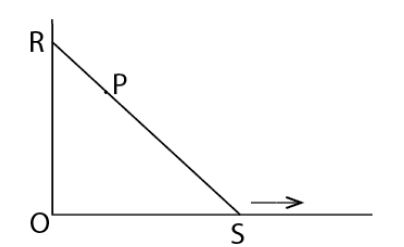
Then the point P(a fixed point on the ladder) lies on
Given that
Then the value of
How many 6X7 matrices are there with entries in {0,1} such that all the row totals and column totals are odd numbers?